AuthorJanel Briggs Categories
All
|
Back to Blog
Where Are You on the Priority List?4/3/2024 Here's a reflection for all the care-takers out there. The mothers, fur-mama's and women in relationships who spend most of their time caring and holding space for other people (whether it be your partner, children, family, or in your friendships). I want to ask you a question: Where are you on the priority list of your life? Recently, I had to ask myself this question. And it's VERY interesting what came up! Last week my husband and I decided to invest in private 1:1 coaching for our son (who is 10yo) for a sport he loves. This coaching would help him to build more confidence and fine tune his skills. I did my research, got a referral, and the quote came back at $200 for a number of sessions. It was literally a split-second decision - YES, let's do it! Within 24hrs the first session was set up. It was a "no-brainer" for us to spend $200 on our son's progression in this sport, his happiness is high on our priority list. On the flipside, I reflected on how I would have responded if the tables were turned a few years ago. I wondered how long it would have taken me to DECIDED to spend that same $200 on myself??Perhaps you could ask yourself the same thing? I can tell you, the decision would have taken wayyyy longer than 24hrs!! My mind would have been spinning thinking about all the justifications, the pro's and con's, in an attempt to ward off the overwhelming feeling of... GUILT. "I can't do that, I can't spend that much on myself... it's too much! I'll find another way. I'll get another quote. I'll wait to see if I REALLY NEED IT." 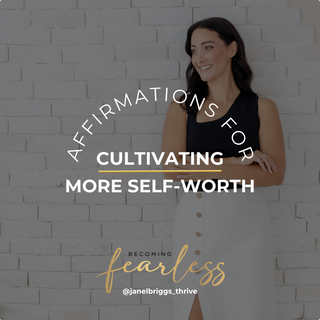 You may have had a similar response or mindset too?I've had clients tell me they're kids are always dressed in the best clothes - yet they're still wearing those old shoes with the hole in them they bought 5 years ago! Or, they'll even pay for the finest food, toys and new beds for they're fur babies - yet they're still using a broken hair brush from 2012! Or, they won't even blink an eye at loaning a family member or friend money to support their idea or dream - yet won't do the same for themselves! WHY ARE WE LIKE THIS??Honestly, I believe it comes down to priority and self-value. Where we place ourselves on our own priority list matters. We forget about how important it is to invest in ourselves, in our own progression, healing and growth. I can tell you that in every decision I used to make - I was at the bottom of my priority list. Somehow in my role as the "responsible care-taker" in my immediate and extended family I thought else's needs came before mine. What I came to realise (after hitting a rock bottom with my mental health in 2017!) is that my needs and taking care of myself HAD to come FIRST. I needed to be a top priority in my life, instead of bottom of the list. If I couldn't make myself a priority and voice my needs - then how would anyone else ever make me a priority too? My last questions for you is this: How can you move yourself up the priority list this week
And if you have any questions or comments on how to get started - please reach out! 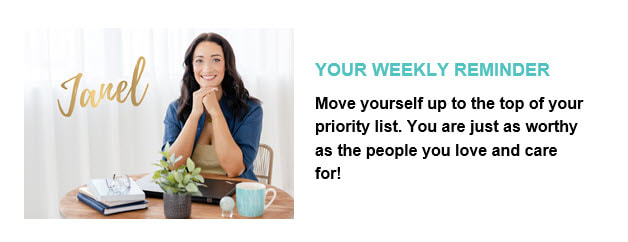 About the Author: Janel Briggs is an Author, Mindset Coach, Practitioner of NLP and Timeline Therapy on a mission to support women across the world in overcoming their anxiety - personal insecurities and professional fears - to build unwavering confidence and self-belief. Mindset Coaching aims to help you fearlessly elevate your life and career, and more importantly the relationship you have with yourself! Connect with Janel on social media via Linkedin or Instagram. 
0 Comments
Back to Blog
When Christmas Isn't Sparking JOY18/12/2023 This time of year can bring up big emotions for people. Not only do we have the overwhelming rush to the end of year finish line, but we also have so much added stress with “Christmas is coming”. I want you to know that if you are not joyously cruising into Christmas and the end of year, it’s OK. You are not alone.  You're not a bad person or the “Christmas Grinch”. You’re probably just extremely overwhelmed, burnt out, beyond tired and perhaps at capacity with everyone and everything! Christmas and the new year often brings up anxiety! I know this feeling. I spent a few years of my life dreading Christmas day and the stress that comes from juggling “family relationships" and having to “act normal” when I felt way less than normal. It’s plain hard to be joyful when your mind feels scrambled and you've got zero energy left in the tank. Not to mention that pressure of staring down the road to 2024 … thinking what am I doing with my life? Why am I still so far away from where I should be? And how the hell am I going grin and bear it and avoid these questions from people at all those Christmas parties?!  If you resonate with any of this, here is an approach for youIf you resonate with any of this, here is an approach for you: Honour your feelings. It’s OK to be feeling this way, there are many other who feel the same right now too but probably aren't talking about it. There’s no doubt you’ve been juggling a lot this year and likely just need time and space to process your thoughts, feelings and emotions. It’s ok to say No. I remember one year when my family asked me to host Christmas Day lunch and I was struggling with my mental health. My anxiety immediately triggered at the thought of seeing everyone in my home roll up with Esky’s full of alcohol and drinking all day. I knew that my head and nervous system could not handle any alcohol fueled arguments or stress. So, with the help of my mentor I crafted some words to create a boundary that honoured my feelings. I wrote to each family member and told them I would host, but if it was at my house, it would be an alcohol-free day. They agreed, respected my wishes and came along. They ate the food, opened presents, left early and went on to be merry somewhere else! By all accounts for me it was a GREAT DAY. Zero anxiety, and lots of laughs. Focus on self-care. Perhaps this is what your holiday break is about, a time for rest and recharge rather than all the Christmas ‘tis. Less giving energy out, more recouping energy in. Do things that bring you comfort and relaxation. You don’t have to have it all figured out by December 31st. In actual fact December 31 is just another day in the calendar. Take a breath and release the pressure. Everything will work itself out in time. Go slow and be kind to yourself. Ande let this be your reminder to take a breather. You can and you will get to that end of year finish line. And please take care out there, if you're stressed and emotions are high remember that there are many others that are too. All the best, JB.  About the Author:
Janel Briggs is an Author, Mindset Coach, Practitioner of NLP and Timeline Therapy on a mission to support women across the world in overcoming their anxiety - personal insecurities and professional fears - to build unwavering confidence and self-belief. Mindset Coaching aims to help you fearlessly elevate your life and career, and more importantly the relationship you have with yourself! Connect with Janel on social media via Linkedin or Instagram.
Back to Blog
Tapping Into the Magic Within You9/10/2023  In my line of work it's common for me to see women grappling with self-doubt. Sadly, this lack in belief can be the major cause of our stress, anxiety, burnout and even depression. We seem to live in a world where women feel there is a persona or invisible achievement list they have to live up to in order to be "worthy" or "valued". Watching the Barbie movie recently, this became even more clear to me. (Have you seen it? What did you think of it?) The gremlin thoughts in our mind often make us feel that if we don't look like THIS, or have THAT, or achieve THIS, then we're failing, "not good enough" or will "never be good enough". It's a pressure that is hard to comprehend and manage. And, if we've experienced knock backs at any stage of our life or career, the journey to quiet the gremlins and get back to self-confidence can be super challenging. But I am here to remind you that this journey back to your true self, can also be incredibly rewarding. Within each and every one of us, there exists a reservoir of magic waiting to be tapped into. Special qualities, characteristics, talents, and brilliance that once recognised helps to light up the world in small or big ways. Learning how to unlock our magic is how we overcome self-doubt. Your magic sparkles from your qualities, strengths, values and known accomplishments. 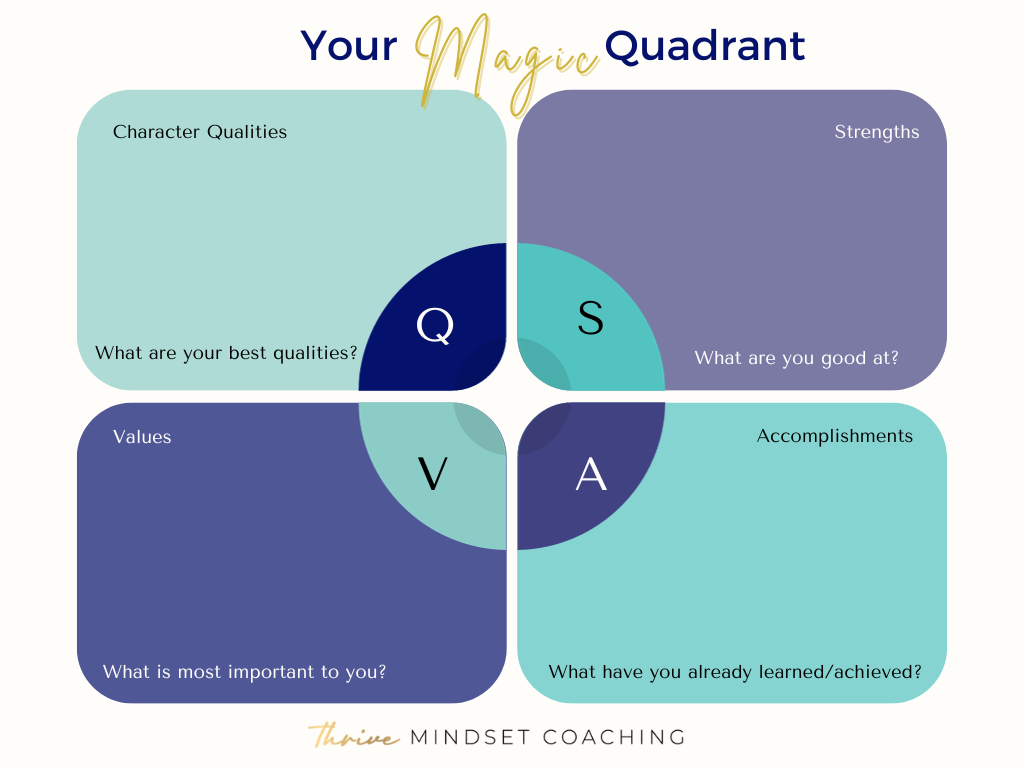 If you're on this journey now - I have created a visual thought starter for you. Take a blank piece of paper, grab a pen, and divide your page into four. Ask yourself each of these questions, and fill in a few dot points for each box. Confidence blooms from deeply knowing and understanding yourself, embracing your unique qualities, and acknowledging your accomplishments. These elements will help you to go onto look at pursuing your passions. Mindset Coaching: The Key to Unleashing More of Your MagicMindset coaching is a powerful tool that empowers women to shift their perspective, challenge their limiting beliefs, and develop the confidence to pursue their goals. Here's how THRIVE mindset coaching can further help you tap into the magic within YOU: 1) Identifying Limiting Beliefs
2) Cultivating Self-Awareness
3) Shifting Negative Self-Talk
4) Setting Empowering Goals
5) Building Resilience
Your inner magic is wating to shine. Remember, you are capable and worthy of achieving greatness! Honour your uniqueness, own your story, and believe in your capabilities. THIS level of radical self-acceptance is where the magic sparkles within you! About the Author: Janel Briggs is a NLP and Timeline Therapy Practitioner on a mission to support women across Australia and Singapore in overcoming their professional anxieties, imposter syndrome, fears and insecurities to build unwavering confidence and self-belief. Mindset Coaching is about learning how to become fearless and level up your life and career! Connect with Janel on social media via Linkedin or Instagram.
Back to Blog
Ever noticed how one little change can set off a chain reaction that shakes up your whole day? Seriously, it's crazy how something as small as a negative thought, or a random comment from someone's grumpy mood can turn a great start, into a bad day. Think about it - ever had one of those mornings where you woke up on the wrong side of the bed? >> Maybe you spilled your coffee, missed your bus, or your child had a stage 5 meltdown over his corn flakes (true story! lol). And then, BAM! That bad mood tags along like a dark cloud, messing with your interactions and choices all day long. It's like that one negative morning experience defines ALL the experiences of your day. And your thoughts then decide to throw a party and invite all your complaining friends in to gripe all day. On the flip side have you also noticed how one tiny 'thank you' or a kind compliment can turn things around and give your mood a 180-degree boost. It's like a burst of sunshine breaking through the clouds. Suddenly, you're smiling, your steps feel lighter, and you're ready to take on the world!  But here's the cool part. We do have a choice; you can choose to react and response, OR NOT.We often feel like we have NO CONTROL over they day, our mood or emotions. So we go on reacting and responding to everyone and everything around us. Imagine what could happen if we stopped giving the negative experience, thought or comment energy?? Here's a few examples of how to flip the script in your mind and rewrite the day: -> Your spill your coffee - old thought: "I am such and idiot, I don't have time for this, this is going to ruin my day!" (self-criticism) New thought: "Woops, well that is annoying - I'll go change now." (compassion) You encounter someone who is rude/grumpy - old thought: "What a jerk, how dare they speak to me like that, why did they have to X - I'm so mad!" (transferred anger) New thought: "Wow, they must be having a rough day" (deflect the emotion) Missed the bus - old thought: "Oh great, now I'm late and today is going to hell." (frustration) New thought: "That's ok, I'll just have to get the next one - nothing else I can do." (acceptance) And, for the women who just feel like they wake up on the "wrong side of the bed" every day ...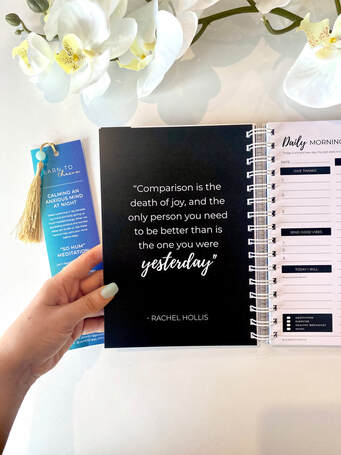 Learn to Thrive ... my morning journal is the ONLY answer for that!Here's why: Every day you have the opportunity to rewrite your day, by following the prompts to set an intention for your day. You begin your day with his simple intention affirmation: "Today I will .... "
By creating an intention for your day you flip the script and become the writer, instead of the audience. I know it seems TOO SIMPLE to be true, but it works. Try it, and see? Ask yourself this: What is my intention for this week? What quality do I want to bring into today? 
Back to Blog
Self-Care Doesn't Have to Be Expensive21/8/2023 In the midst of today's economic challenges, it's understandable that when things get tough, taking care of ourselves often slips to the VERY bottom of the priority list. Everyone, and everything else comes first, I get it. But I want to remind you of two important things - when life/financial/relationship/work stress is high:
Of course, day-spa's and weekend retreats, and nights out with the girls are amazing! But in truth, THE BEST self-care looks like: Setting strong & healthy boundaries around your energy and time! Boundaries are literally the decision you make to put yourself first, even when life is crazy. It's where I say: "This is the energy I will allow in/or the energy output I have capacity for right now" And if you have a tendency to be a people pleaser, have a hyper focus on external validation, or someone who NEVER puts themselves first... I've got a little "Boundaries Bingo Card" ready for you! 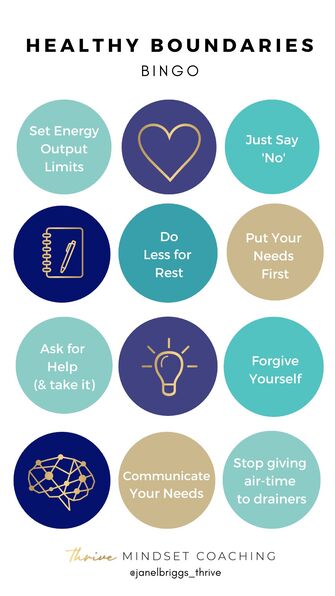 Snapshot that bingo card and this week I would love to inspire you to choose one bubble. Make that one non-expensive thing your self-care focus for this week. And perhaps we need to take a page out of the Baby Boomer's book on the ART OF SAYING NO!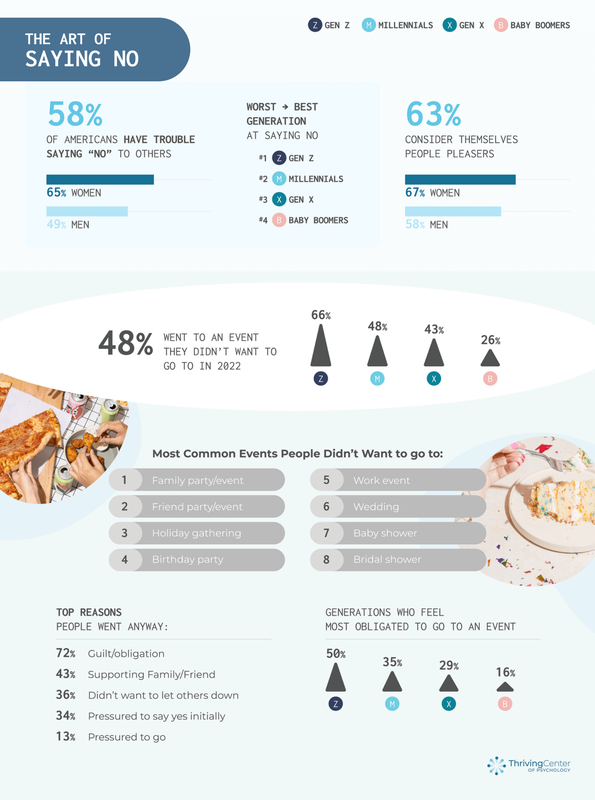 Image & research credit: Thriving Centre of Psychology These stats are crazy right? 65% of women have trouble saying No! Why is it so hard to set boundaries and just say no? As the research above states it comes down to a feeling of GUILT + OBLIGATION. It's high time to flip the switch on that. "If you’re feeling boxed into doing things you don’t want to do, don’t continue the cycle. Now more than ever is the time to prioritize your mental health and your happiness. At the end of the day, that’s what is most important!" - Thriving Centre of Psychology Recently coming off a 7 week summer school break for my son here in Singapore (with a lack of affordable school holiday programs) I was chatting to another Mum about how we've coped. She said "Wow, you've got strong boundaries!" I said yes absolutely. I've hit burnout enough times(!) to learn what I need to operate at my best, and now I honour that. These are some of the self-care habits that I stick to. Self-Care habits (without the price expensive tag):
Remember, you're worth every effort you invest in yourself. Life is always going to be busy, and I know you probably don't have the time, energy, or resources right now for self-care. But if you don't put yourself on the priority list now... who else will? Any comments or questions, please reach out.  About the Author: Janel Briggs is a NLP and Timeline Therapy Practitioner on a mission to support women across Australia and Singapore in healing their professional anxieties, insecurities and imposter syndrome to build unwavering confidence and self-belief. The goal is to level up your life and career by learning how to to live fearless and anxiety free! Connect with Janel on social media via Linkedin or Instagram.
Back to Blog
Busy Isn't Always Better14/8/2023 Have you inadvertently fallen into the trap of becoming addicted to that constant state of being busy? We've grown accustomed to this continual rush, over-committed on the move. And I get it, there is always so much to do. Work, home, family, life. We live in an "on demand" society, where everything is urgent, and everyone expects everything to be done yesterday. Now, I'm not saying being busy is inherently bad. We definitely have learned how to multi-task and get sh*t done! But let's be real - when we are sucked into this whirlwind of non-stop activity, we often disregard own own well-being and miss out on the subtle signals our own bodies are trying to send us. Research shows that a third of Australian’s are under “chronic time stress”.
Higher levels of time stress are correlated with worse mental health, lower self-rated health, less exercise and lower life satisfaction. (sourced: https://pursuit.unimelb.edu.au/articles/a-third-of-australians-under-chronic-time-stress) And have you ever noticed that after a crazy stretch of hectic months, the moment you finally give yourself a break, take a vacation or even just a single day off - you end up falling sick? Here's why:
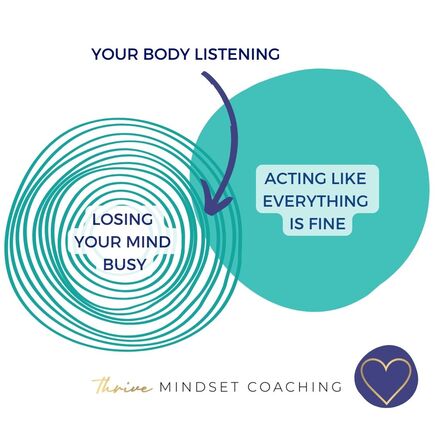 So, my message is this: Busy isn't always better. Could "busy" taking you away from something you don't want to deal with? What is your constant "need to be busy" behaviour telling you? Take a moment to reflect today:
And let's stop wearing "busy" like a badge of honour and telling each other how busy we are. I would much rather hear about how quiet, content and happy you've been! The truth is, when your life is jam packed – you’ll be less likely to have time to be present from the multi-tasking and external noise. And being present is the place where feel MORE happiness, joy and contentment. What’s more important? Janel Briggs If you need support to help you release stress and calm your mind check out my free guided meditation here for relaxation.  About the Author: Janel Briggs is a NLP and Timeline Therapy Practitioner on a mission to support women across Australia and Singapore in healing their professional anxieties, insecurities and imposter syndrome to build unwavering confidence and self-belief. The goal is to level up your life and career by learning how to to live fearless and anxiety free! Connect with Janel on social media via Linkedin or Instagram.
Back to Blog
 Finding motivation, and achieving a work-life balance are two topics that come up a lot in my coaching, and truthfully, it’s taken me a long (very long!) time to work out the formula to this problem. I don’t know if you can relate to this, but I’ve always been the sort of person who is “ALL IN 100%” on something. In my corporate career if I was working on a deadline, I was ALL IN, meaning motivation for ANYTHING else in my personal life got pushed to the bottom of the list. Later, owning my own business in the early years, if I was working on a project, or studying, or exploring a new idea, I was ALL IN and my motivation for healthy habits like exercise, eating well or sleep got skewed. And if I was focusing on living, enjoying personal time OFF work, travelling (or at times battling my own mental health journey) - then I was completely checked out and unmotivated for work, exercise or ANYTHING else! If you are an ALL IN kind of person, I want you to know that this isn’t necessarily a bad thing. There is no doubt, you’re a go getter and have probably achieve great outcomes! Until… you hit burnout, or the all or nothing mindset becomes an issue and other areas of your life begin to fall apart. What I realised is that my mind was stuck believing these three things: 1. TO FEEL THE BENEFITS OF THE ELUSIVE WORK-LIFE BALANCE MEANT MY TIME HAD TO BE DIVIDED IN EQUAL PARTS.So, in order to be “in balance” I thought I had to dedicate 1/3 of my time to work, 1/3 of my time to family, 1/3 of my time to personal every week. However, I call this elusive as this is an unrealistic goal. Nothing in life happens in equal parts! As humans we are cyclical beings. Every year our planet runs in seasons – no matter where you live there is a cycle and a change of season. Some countries like here in Asia has 2 seasons (dry/wet), where the majority of the rest of the world has 4 distinct seasons. It's planetary. As women our body runs in hormonal cycles, which means our energy levels will always be in flux. Science tells us that there are certain times within our hormonal cycle that are better for productivity, exercise, and rest. It’s biological. When I started to understand and accept that life also runs in cycles and seasons, I began to feel more motivation and my mind expand with self-compassion. Consistent MOTIVATION is cultivated from self-compassion, NOT GUILT. In the cycle of life there will be months where work takes priority, and weeks where family takes priority, and then other times of the year when your personal and health goals will take priority. Ask yourself this: What is the most important thing you need to be focusing on - right now this week or month? Now, if I am in a season of increased work or study, then it’s I allow myself to create boundaries around my energy and reduce plans, commitments or tasks in other areas of life. Similar for family and person life. The key is to:
Flowing within the cycle you are in, instead of berating yourself for not doing X or achieving X - means you’ll be more motivated. 2. I DIDN’T UNDERSTAND HABIT CHANGE AND BELIEVED I WAS UNMOTIVATEDLet’s talk about habits for a minute. We learn habits through our conditioning, or from repeated past experiences. Our habits become imprinted as patterns or programs within our nervous system and brand, stored within the 95% unconscious part of our mind. Once a habit (good or bad) is formed it occurs outside of our conscious awareness, and will continue operating the same program until a time where you bring the habit into your conscious awareness, and create a shift or change. We all get so frustrated with ourselves and inflict so much guilt whenever trying to break “bad habits”. But, I think the main point we forget is that if habits are learned from repeated past experiences – then we have to CONSISTENTLY repeat the experience, until which time the unconscious mind re-programs a new pattern. The first step to habit change is always AWARENESS. Becoming consciously aware so that you can see these patterns and "wake yourself up" to a new way of living. As yourself this: What habits in your life today are working for you, or against you? 3. I COULDN’T LOVE, BE PROUD AND APPRECIATE MYSELF UNTIL I HAD ACHIEVED (XYZ) There is nothing more un-motivating that trash talking yourself. I call GUILT the swampland of the soul – guilt will always keep you STUCK in the place you are in. If your mind is on a loop of dishing out rude comments, telling you how bad you are and filled with negative self-talk – then you are ALWAYS going to feel unmotivated to do the THING. No matter what the THING is! Self-acceptance, and taking action are how you are going to stay motivated and find your version of work-life balance. As yourself this: Wherever you are right now, love yourself for the cycle you are in. 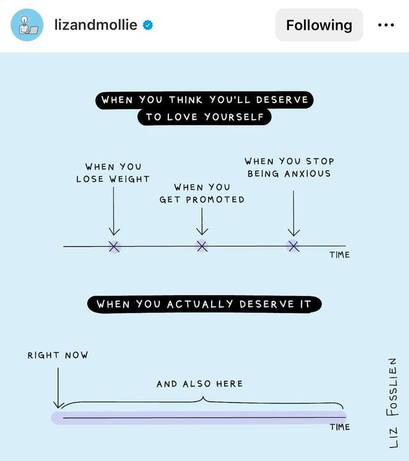 Photo credit: @lizandmollie There is nothing more un-motivating that trash talking yourself. I call GUILT the swampland of the soul – guilt will always keep you STUCK in the place you are in. If your mind is on a loop of dishing out rude comments, telling you how bad you are and filled with negative self-talk – then you are ALWAYS going to feel unmotivated to do the THING. No matter what the THING is! Self-acceptance, and taking action are how you are going to stay motivated and find your version of work-life balance. As yourself this: Wherever you are right now, love yourself for the cycle you are in. And if you don’t know where to start to bring kinder thoughts into your life… begin with reading, writing or speaking positive affirmations every day. Powerful "I am" and affirming statements. This healthy mindset habit that is going to help you to feel more motivated and shift your mindset to having more positive thoughts. >> If you're new to this concept I have a free guide to help you get started >> DOWNLOAD MY FREE AFFIRMATIONS LIST HERE THIS is the one habit you want to start, and even better - it's completely free. As you navigate and redefine what work-life balance looks like for you personally take this newfound awareness and embrace the cycle or season you are in. Whenever you find yourself off chart, you can always reset. But, remember the foundation of your motivation will be built on self-compassion, not guilt.  About the Author: Janel Briggs is a NLP and Timeline Therapy Practitioner on a mission to support women across Australia and Singapore in healing their professional anxieties, insecurities and imposter syndrome to build unwavering confidence and self-belief. The goal is to level up your life and career by learning how to to live fearless and anxiety free! Connect with Janel on social media via Linkedin or Instagram.
Back to Blog
Escaping the Trap of a Lack Mindset19/6/2023 Do you ever catch yourself fixating on what is lacking in your life?  All the things you don't have... all the things that aren't going well for you? "I don't have enough X (money, time, friends) Why can't I have a new X (job, relationship, car, house, handbag, etc) like so-and-so?!?! I never get the X (good opportunities, promotions, luck)" Leaving you feeling unfulfilled, and on a constant churn of stress while pushing and striving for more? It's easy to fall into the trap of longing for all that we don't have. I've certainly done it. Too busy looking over someone else's fence at what they're doing, instead of focusing on being present in my own backyard. We live in a world that often emphasises comparison and scarcity; Social media is a huge trigger. If you've been wondering, how to get out of this lack mindset and feel good about your life, you probably don't realise that you have a few things within your control today, that can help you shift your mindset. Even if you stay in exactly the same position you are in. Here 's how to get started: 1) Cut Down Social MediaIf you are following accounts that make you feel "ick" after scrolling, then mute these accounts for 30 days. See if you missed the content?? If you did, then go back to it and re-test how you feel after a break. If you didn't miss it at all, and you noticed a positive shift ... then unfollow the account. Social media's general purpose is for connection and entertainment. If you're not feeling those things, then you won't miss anything that was good for you! 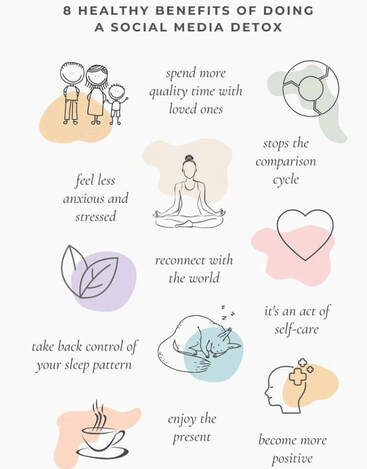 (original source unknown, found Instagram @itssarahbryant) 2) GratitudeI know, I know... everyone talks about gratitude. But that's because it works! Science tells us that when you shift your focus to appreciate what you already have, you'll feel MORE content. "I am grateful for... " Write down 3 things you are grateful for every day, on paper, in a journal, or your phone. I've even had a client who prefers to voice note her gratitude while she walks in the morning! Love it. A few years ago I read a phenomenal book by Louise Hay, called “You can Heal Your Life”. Louise is the grandmother of self-help books and the queen of affirmations and gratitude. One chapter in the book was really transformation for me. Louise talked about her own feelings of lack around money, and fear of her finances. To combat this anxiety and overwhelm she use a small shift in language that had a huge impact. Each and every time a bill arrived in her mailbox; she would BLESS THE BILL and say: "Thank you for the money in my account to pay for this bill. I appreciate this bill, knowing I have the funds to pay for it." And, somehow she would find the money to pay for the bill, without stress. Wow, what a concept! Even reading this - how different does that feel? 3) Celebrate
We also usually are not comparing apples with apples. We get stuck looking at other people’s success and comparing our apple experience with their orange experience! It just doesn’t make sense. Celebrate your big and small steps. “I am proud of myself for … “
Look around you right now. Where are you sitting? What do you already have around you right now? Little moments happen every day that are proof that you are on your way to abundance, look for them and celebrate those moments. 5 years ago, I used to DREAM of the coaching business I have now! Imagine if I had of given up … because I got stuck in comparison and lack? There was healing, learning and growth I needed in order to become the Coach I am today. It was all worth it! Author Gabby Berstein in her book Super Attractor has this wonderful concept she uses for celebrating and focusing on abundance. It’s called “Gathering Twigs”. You create a list on your phone and every time you have a win, something good happens, or there is a sign that shows you that you are on the right track, you write it down. I did this FOR YEARS. And it works. Anytime I felt lack or comparison, I would start a new list. Looks like this: 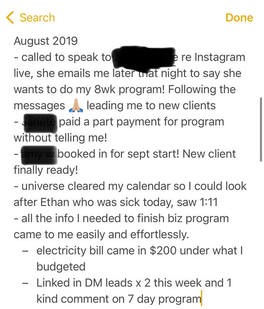
Comparison and judgement lead to resentment. Resentment is like anger, it can be toxic and poisonous. It will eventually eat away at the container it is in. If you are walking down the street and notice a woman with great shoes, and immediately you feel envy - compliment her. Either out loud to her, or in your mind. Sounds like: “Wow, amazing shoes, I love them”. If you are scrolling social media and notice someone who is celebrating and achievement and you immediate feel less than, or upset that you don’t have what she has – celebrate her. Sounds like this: "Well done, that's amazing. Good for her getting that new (job, relationship, house xyz). I know I am on my way to getting that soon too." See how different it feel? Remember, your journey is unique. You can and you will get to where you want to be. Staying present in your life, focusing on gratitude and celebrating your accomplishments is how you will get there. All the best, JB
Back to Blog
 Have you ever found yourself seeking happiness through external validation? For years, I placed my happiness in the hands of others, constantly thinking that if certain people or circumstances aligned in a certain way, then I would finally be happy. I would catch myself saying things like, "If my parents, sister, husband, son, boss, colleague, or X did THIS, then I would be happy." I tied my happiness to achieving good grades, receiving recognition at work, earning a promotion, or even reaching specific milestones in my first business. My joy was dependent on external factors and the validation they provided. The problem was, and what I've realised through Mindset Coaching, is that MY long term happiness is an internal job... I am the only one that can change it or make it happen. Yes, the external factors could give me a temporary hit of happiness, BUT they could never give lasting contentment. Here's why:  * We cannot control the external factors! Or other people's opinion of us * We cannot control how much or little someone loves us! Or HOW they specifically show us love The key was... I had to learn to know, love and accept MYSELF (all facets and parts of me) - in order to find my self-worth and experience a contentment that I never even knew existed. And the most amazing thing happened, when I stopped seeking external validation... I got my power back! In this video, I share the three crucial steps I took to break free from the cycle of seeking external validation and find true self-worth. Let me detail the 3 steps I took for you here: 1. Get clear on what is in your control and what isn'tI learned that I cannot control other people's actions, reactions, behaviours or even the way they love and treat me. I cannot control every single outcome, to every situation in my life. There will be uncertainty, there will be change, there will be things that do not always go my way. No matter how hard I work or try to make it different. I can only control what is within my circle - my mind, my body, my emotions and my behaviours. How I think, reaction and respond is up to me. 2. Start your day with a focus on self-careI started my day with a simple shift. In order to love myself fully and build self-worth I need to be the most important person in my world, my needs matter. My own self-care has to be a priority. I decided to wake up 15 mins earlier, to sit listening to a short 5 min guided meditation and I did 10 mins of journaling positive affirmations - something I had never done before! (If you are new to meditation I have a few to help get you started here) I spent 10 mins stretching and doing yoga, then ate a healthy nourishing breakfast and I listened to music while getting ready for work. I found this short 20-30mins of "me-time" first thing in the morning would calm and refocus my mind, before the chaos of the day began. When I filled my "needs cup" first, I found I wasn't looking to other people or external factors to fill my own needs. 3. Do one thing this week that brings you JOYI began a new habit where once a week I would do something that brough me joy - something just for me. Where I didn't have to do anything for anyone else. You see, I began to remember who I was outside of all the labels and hats I wore. Outside of the expectations, demands, stress and achievements of work. I started to love and reconnect to my inner child, the part of me that had gotten lost from putting all my happiness eggs outside my own basket. The part of me that was waiting for someone else to love, care and adore me, the way I wanted. It's an empowering feeling not waiting for someone to give you everything you need. I began to breathe easier and smile more often. Life felt less heavy and more enjoyable. I realise that it had to start with me, just like it has to start with you. And I am here to tell you - YOU can absolutely do it too. JB  About the Author: Janel Briggs is a NLP and Timeline Therapy Practitioner on a mission to support women across Australia and Singapore in healing their professional anxieties, insecurities and imposter syndrome to build unwavering confidence and self-belief. The goal is to level up your life and career by learning how to to live fearless and anxiety free! Connect with Janel on social media via Linkedin or Instagram.
Back to Blog
The most important day, is the day you decide your mental health is what matters most. Once you create this mindset shift, you'll find quite a few things get easier to manage:
I think so much of the time, as women, we feel like putting ourselves first is somehow selfish. But, it's not. It's actually healthy! How can you continue to give the world from an empty cup? I certainly couldn't. I was at the rock bottom of my priority list. My cup was so empty when I first recognised my mental health was a problem, I couldn't even muster the energy to get out of bed to feed my 3yo son. (Tap to listen to my story...)
Your Mental Health Matters.My first (and biggest!) mindset shift was recognising that I was the only person who could actually change that situation. No one was coming to fix me. No one was coming to save me. I had to be the one who decided enough was enough, it was time for something to change. My wish is that I can empower you with 5 Simple Questions for Checking in on Your Mental Health so that your life doesn’t get to its lowest point, before you decide it’s time for something to change. Let's get into it: 1. How am I feeling emotionally right now? Checking in on your emotional state is an important step in assessing your mental health. Ask yourself: “How am I feeling in this moment?” “How long have I been feeling this way?” In times of external stress, we often deny our emotions, push them down and say, “I’ll deal with that later, I don’t have the time for this”. The funny thing about emotions is… we have to feel them, to heal them. Our emotions will continue to arise, in small or big ways, until we do. And at some stage they could even become super overwhelming - anxiety, anger, frustration, sadness – derailing you from every day life. 2. Am I taking care of my basic needs? Mental health is closely intertwined with our body’s wellbeing. Your body may begin to show symptoms of poor mental health before you even realise it consciously. Muscle tension, pain, feeling restless, headaches, insomnia, appetite changes are all key symptoms. Ask yourself: "Are you getting enough sleep, skipping meals, eating balanced meals, and engaging in regular exercise?" Neglecting your body’s basic needs can contribute to fatigue and the body’s stress. If you are not well slept and nourished, the mind has less resilience and finds it harder to process stress and emotions. 3. Am I managing stress effectively? Are you feeling overwhelmed and constantly under pressure?
Take a look at your coping mechanisms and self-care practices. Health stress management can be as simple as making time to move your body, meditate, journalling your thoughts or connecting with a friend – after a rough day. 4. How are my relationships influencing my mental health? Our relationships and the people in our life play a crucial role in our mental health. Ask yourself “Do you feel supported, valued, and respected?” “Do the people you spend time with uplift you, or drain you?” “Is this connection healthy for me right now”? Perhaps it’s time to create a healthy boundary and/or take some time away from the people who maybe feeling toxic right now, to recoup your energy. 5. Am I engaging in activities that bring me joy and fulfilment? When our external stress is at capacity, we forget about the simple act of doing things that bring us joy. If you are giving out all your energy to work, or other people’s problems – life is going to feel bleak really quickly. Ask yourself: “When was the last time I did something just for the fun of it?” “What is one thing that I could do, to bring more joy into my week?” If you’re looking for ideas for spending quality time with yourself, perhaps try one of these:
Remember, checking in on your mental health is an ongoing process. It’s essential to be honest with yourself and seek support if you notice any persistent concerns or challenges. There is no downside from ever working on your mindset or making some simple chances to your daily habits!  About the Author: Janel Briggs is a NLP and Timeline Therapy Practitioner on a mission to support women across Australia and Singapore in healing their professional anxieties, insecurities and imposter syndrome to build unwavering confidence and self-belief. The goal is to level up your life and career by learning how to to live fearless and anxiety free! Connect with Janel on social media via Linkedin or Instagram. |

 RSS Feed


|

|
Stay Connected
Subscribe and be the first to access new blog content news & updates. |