• 1:1 Coaching
    • Rediscover Your Spark
    • Client Testimonials
  • Resources
    • Positive Affirmations
    • Guided Meditations
    • Books & Guides
  • Store
  • About
    • My Story
    • FAQ >
      • What is NLP and TimeLine Therapy?
      • What are limiting beliefs?
      • What are Negative Emotions
      • Relieving stress & anxiety
      • What is a growth mindset?
      • Can Meditation remove negative thoughts?
    • Contact
  • Blog
  • EWC
  • 1:1 Coaching
    • Rediscover Your Spark
    • Client Testimonials
  • Resources
    • Positive Affirmations
    • Guided Meditations
    • Books & Guides
  • Store
  • About
    • My Story
    • FAQ >
      • What is NLP and TimeLine Therapy?
      • What are limiting beliefs?
      • What are Negative Emotions
      • Relieving stress & anxiety
      • What is a growth mindset?
      • Can Meditation remove negative thoughts?
    • Contact
  • Blog
  • EWC
Thrive Mindset Coaching
  • 1:1 Coaching
    • Rediscover Your Spark
    • Client Testimonials
  • Resources
    • Positive Affirmations
    • Guided Meditations
    • Books & Guides
  • Store
  • About
    • My Story
    • FAQ >
      • What is NLP and TimeLine Therapy?
      • What are limiting beliefs?
      • What are Negative Emotions
      • Relieving stress & anxiety
      • What is a growth mindset?
      • Can Meditation remove negative thoughts?
    • Contact
  • Blog
  • EWC

THE NEXT CHAPTER

GUIDANCE FOR WOMEN NAVIGATING MAJOR LIFE TRANSITIONS & THE JOURNEY BACK TO THEMSELVES
Don't miss a thing! Subscribe for free weekly coaching inspiration and support
SUBSCRIBE NOW


    Author

    Janel Briggs
    Empowering Women to Become Fearless & Confident through Major Career & Life Transitions

    Categories

    All
    Affirmations
    Anxiety
    Burnout
    Business
    Career
    Christmas
    Coaching
    Communication
    Comparison
    Criticism
    Fear
    Fear Of Failure
    Goal
    Goal Setting
    Growth Mindset
    Habit Change
    Identity Crisis
    Imposter Syndrome
    Job Satisfaction
    Judgement
    Mental Health
    Mindfulness
    Mindset
    Morning Routine
    Overwhelm
    People Pleasing
    Perfectionism
    Relationships
    Self Care
    Self-care
    Stress
    Success
    Suicide Prevention
    Validation
    Values
    Worry

    RSS Feed

Back to Blog

How to Build Self-Trust and Make Confident Decisions as a New Leader

21/10/2025

 
Picture
During a recent leadership coaching session, one of my clients, a highly capable, intelligent woman new to a management role—shared something powerful.

When I asked what her biggest roadblock was to feeling confident as a leader, she said:

“I always doubt myself. I worry that I don’t make good decisions.”


That statement stopped us both in our tracks.

Decision-making is at the heart of leadership.
Yet when self-doubt takes over, hesitation creates confusion, delays action, and builds anxiety. Over time, it can even erode trust—both in yourself and from your team.

I followed up by asking, “How long have you felt this way about your decision-making?”

​Without hesitation, she replied, “My whole life”.

How Limiting Beliefs Form in High-Achieving Women

Language patterns, especially the negative ones we repeat often reveal the root cause of our most persistent challenges.

“The words we use to describe our fears often reflect our deeper inherited belief system.” —Mark Wolynn, Inherited Family Trauma

​When we explored deeper, my client’s language uncovered a core limiting belief around decision-making. One likely shaped by past experiences or subtle messaging that said:

  • “I can’t trust myself to make good decisions.”
  • “If I make a wrong decision, I’ll be judged or seen as a failure.”
  • “I feel pressure when I have to make decisions.”

This belief had quietly sabotaged her leadership confidence for years. It created hesitation, second-guessing, and kept her from showing up as the decisive, grounded leader she truly was.

And here’s the truth — this limiting belief is incredibly common among high-achieving women.

From my experience as a mindset and confidence coach, I often see how past mistakes, criticism, or even the opinions of others plant seeds of self-doubt that undermine leadership capability for years—sometimes decades.

Over time, that seed becomes a core belief that shapes identity:

“I can’t trust myself. I don’t make good decisions.”

Why Self-Trust Matters in Leadership

A lack of self-trust doesn’t just affect your confidence, it influences every decision you make as a leader. It fuels hesitation, delays, and reliance on external validation. Slowly, it chips away at your authority and your team’s trust in your leadership.

But here’s what I want every woman in leadership (or aspiring to be) to know:

👉🏼 Making good decisions isn’t a gift. It’s a skill.

And like any skill, it can be learned, practiced, and strengthened—with the right mindset, awareness, and tools.

In NLP (Neuro-Linguistic Programming), we understand that your core beliefs shape your behaviors. If you believe you’re not good at making decisions:
​
  • Your brain unconsciously looks for evidence to reinforce that belief
  • You hesitate, overthink, and delay action
  • You convince yourself you need more research or more experience before acting.
  • You seek unnecessary validation from others, adding to the confusion.
  • And you unknowingly prove that belief true—again and again

But when you reframe the belief to something empowering “I am learning to make strong, aligned decisions with confidence” everything begins to shift.

Why Reframing Matters for Leadership Confidence

When a leader is indecisive, it ripples through the team. Projects stall. Communication breaks down. Trust weakens.
But when a leader steps into certainty and self-trust—even when the path isn’t perfect, it builds momentum. It inspires confidence in others. It models resilience and accountability.
That’s why reframing limiting beliefs around decision-making isn’t just about you, it’s about everyone who looks to you for guidance and vision.

5 NLP-Inspired Coaching Strategies to Strengthen Your Decision-Making Muscle

1. Get Clear on What Success Looks Like for You and Your Team

Many poor decisions come from a lack of clarity about what success truly means. As a leader, it’s not just about what you want. It’s about creating a shared definition your team can rally behind.

Ask yourself:
  • What outcome do we truly want to achieve as a team?
  • How does this decision align with our values and bigger objectives?
  • If fear of judgment wasn’t a factor, what would be the most impactful choice?

When clarity and communication are strong, your team moves forward with alignment and confidence.

2. Separate Emotion from Evidence
First, calm your emotions. When fear, pressure, or anxiety are high, your nervous system hijacks rational thinking.

Step away. Take a few deep breaths or a short walk. A calm body creates a clear mind.
Then try this NLP reframe:

Think of a mentor or wise woman you admire—someone grounded and calm under pressure. Step into her shoes.
Ask:
  • How would she see this situation?
  • What decision would she make if she were in my place?
When you shift perspective and regulate your emotions, clarity returns and the best path forward becomes obvious.

3. Write a Pro/Con List But Make It Strategic

This isn’t just about listing positives and negatives. As a leader, your choices impact people, culture, and outcomes.

For each option, ask:
  • What are the short- and long-term benefits or risks?
  • How will this impact my team, values, and overall goals?
  • Which choice aligns best with our strategic direction?

This process blends logic and intuition—two essential leadership tools for confident decision-making.

4. Weigh All Options (Even the Uncomfortable Ones)

Sometimes the best decision is the one you’re avoiding. It might involve confrontation, change, or saying no and that’s okay.

Ask yourself:

“What option would I consider if I knew I couldn’t fail?”


Exploring discomfort builds courage. Great leaders make aligned decisions, even when the answer feels risky.

5. Consider the People Impacted

Strong leadership decisions are made in context. They take into account the people affected - your team, clients, or community.

Ask:
  • What matters most to those impacted by this decision?
  • How can I align my choice with their priorities without compromising my own values?

​This is emotional intelligence in action—the foundation of trust and sustainable leadership.

Leadership Confidence Comes From Self-Trust

Here’s what I told my client at the end of our session:

“You’ve already made countless good decisions. You just haven’t always stopped to celebrate them. Every time you trust yourself and act with clarity, that old belief ‘I don’t make good decisions’ loses its grip.”

Leadership isn’t about never making mistakes. It’s about learning to trust yourself through the process.

You’re allowed to learn as you go. You’re allowed to get it wrong. That doesn’t make you a poor decision-maker—it makes you a growing leader.

When you build self-trust, you not only make stronger decisions - you model confidence, courage, and resilience for everyone who looks to you for guidance.
​
Picture

If you’re ready to break the cycle of overthinking and self-doubt, my Next Level You 8-session coaching program is designed to help women build deep self-trust and confidence from the inside out.

'NEXT LEVEL' YOU
0 Comments
read more
Back to Blog

Has Anyone Ever Doubted Your Potential?

3/10/2025

 
​Words and opinions can cut deep. Especially when they come from someone we admire, or someone in a position of authority.

And sometimes, the words we hear in our younger and most formative years echo in our minds for years and even decades later.

Maybe it was a comment you overheard someone say, or an opinion that was made about your capability. An offhand remark from a teacher, a family member, or even a boss that stuck like super-glue to your young mind's identity.
​
And without realizing it, you’ve spent your whole life trying to prove them wrong.
That was the story of my client, Heidi.

When High Expectations Turn Into Self-Doubt

On the outside, Heidi was the definition of “success”. She was a high-performing leader, in a fantastic role, valued by her organization and known to be a person who always strived to go above and beyond.

But on the inside, her inner critic was screaming "you'll never be good enough" on loud speaker.
  • Anxiety disrupted her days and her sleep
  • Work felt exhausting on the constant spiral of overthinking
  • And the pressure she placed on herself second-guessing every decision clouded her mind

Heidi described it this way:
💭 “I’m placing pressure on myself to perform outside my already high capacity, worrying what others think, constantly overthinking things outside my control, and generally feeling like I’m not achieving - when those around me have praise for who I am and what I do.”
Sound familiar?

​
This is the reality for so many perfectionists and high-achievers. You push yourself to impossible standards to achieve many accomplishments - but instead of fueling confidence and pride, those expectations quietly fuel anxiety and burnout.
Picture

The Root Cause of the Lack in Confidence? A Two Decade Old Self-Limiting Belief

Through our coaching together, we uncovered the deeper fear driving Heidi’s perfectionism and self-belief. It all traced back to ONE sentence she overheard someone in a position of authority say about her as a teenager:

“She’s never going to amount to anything.”

Imagine your younger self hearing those words.

The impact can go one of two ways:
  1. You might take the anger and hurt and use it as fuel to prove them wrong, pushing yourself harder and higher… or
  2. You might absorb the fear and pain as fact, letting it quietly sink into your identity and self-worth
For many women the impact usually depends on how much importance they placed on the person who said the words.

For Heidi, the shock, embarassment, hurt, shame and confusion were far too much for her young mind to process.

As often happens, Heidi held an uncomfortable mix of BOTH impacts - driving achievement on the outside, while eroding confidence on the inside.
What if they're right about me? It's probably true. If they believe it, then it must be right. Maybe I'll never amount to anything. 

What we uncovered together in coaching:​

Those words took root and became a self-limiting belief in Heidi's unconscious mind. Quietly shaping how she saw herself for years to come and the reason she was on a perpetual anxiety-burnout cycle in almost every job she held.

Every achievement, every promotion, every late night working was, in some way, tied to proving that belief and that person wrong. Over time that person became her inner critic, the relentless reminder of not being enough, the constant shadow on her achievements.

This is what limiting beliefs do:
​

  • They keep us trapped in cycles of overachievement
  • They fuel imposter syndrome and self-criticism, even when others praise our work
  • They push us towards burnout, with pressure that never lets up
  • And they drain the happiness from success

The Transformation: From Perfectionism to Confidence

After just 8 weeks of working together, Heidi experienced a huge shift. Through a powerful Timeline Therapy® process we released the old limiting belief and insecurities driving her perfectionism and reframed her relationship with success.

Within weeks Heidi was:

  • Promoted into an incredible leadership role
  • Saying yes to speaking engagements she once avoided
  • Making future decisions with clarity, confidence, and self-belief

​Today, Heidi is thriving in a senior leadership role and serving on multiple boards, dedicating her expertise to companies and causes she’s truly passionate about. Not to prove anyone wrong, but because she believes in her own potential.

How to Release the Pressure Yourself

If you’ve been carrying the weight of someone else’s words (or your own impossible standards) here’s where to start:

  1. Notice the trigger → What situation makes your inner critic the loudest?
  2. Name the belief → Underneath all the layers of noise what is the core belief you've decided to be true about yourself?
  3. Is this your belief or someone elses? → Whose voice are you still carrying? Is it even yours?
When you move from proving yourself to believing in yourself, everything changes.

​-Janel Briggs, Confidence & Mindset Coach

Picture

Ready to Reclaim Your Confidence?

Heidi’s story is proof that you’re not defined by the doubts of others - or the impossible expectations you’ve placed on yourself.
​
If you’re ready to release the pressure, break free from old patterns and belief's that have been holding you back from your true potential, I’d love to support you.

My 'University of You' mentoring program is now open for October enrollment.
Book a free Confidence Kickstart Session Today
0 Comments
read more
Back to Blog

How to Stop Comparing Yourself at Work: Build Confidence & Embrace Your Leadership Style

8/9/2025

 
From an evolutionary psychology perspective, caring about others’ opinions is part of human nature. For centuries, this wiring helped humans survive.

As social beings, we could only endure the harsh environments of early life in groups.

Acceptance meant safety, food, and protection. Rejection meant danger and even death in certain situations. Because of this deep need for belonging, our brains evolved with a sensitivity to social approval and a fear of rejection.

But in today’s workplace, that same instinct often works against us.

Instead of helping us thrive, it can trigger comparison, erode confidence, and leave us second-guessing our capabilities.

One of the most common struggles I see in the professional women I coach is the habit of comparing themselves to colleagues. 

Especially when a new leader emerges with a different leadership style.
​

This kind of workplace comparison doesn’t just drain your energy. Left unchecked, it can spiral into what I call comparisonitis, a constant loop of “I’m not enough” even when you’re more than capable.
​

Why Comparing Yourself to Colleagues Fuels Self-Doubt

A client of mine, let’s call her Rachel, had just stepped into a middle-management role. She was excited. This was the career move she had worked so hard for.

But instead of leading her team solo, the company brought in another manager to share the responsibility. We’ll call her Claire.

Claire was outgoing, extroverted, and at times polarizing. The type of leader who could energize a room, but also miss the small nuances when she jumped out of the gates like an excited bull.

Rachel, on the other hand, was thoughtful, deliberate, and more reserved in her leadership style.

Two leaders. Two very different approaches.

On paper, it should have been a perfect match of complementary skills. But in practice, Rachel started slipping into comparison:

💭 “Am I right for this role?”
💭 “I don’t have what she has.”
💭 “Will I still be effective if I’m not like her?”


Instead of stepping into her strengths, Rachel began working longer hours, overthinking every decision, and quietly questioning her place.

This is the trap so many women fall into: when leadership styles clash, comparisonitis creeps in and it convinces you that somehow different means less.
​

The Truth About Different Leadership Styles

Here’s the shift Rachel discovered through our coaching:

Different does NOT mean LESS.

She didn’t need to match Claire’s extroverted presence. What she needed was to recognize and own the value of her own authentic leadership style:
​
  • Her deep listening created psychological safety for her team
  • Her thoughtful questions surfaced issues earlier, reducing conflict
  • Her measured approach brought clarity and confidence to her decisions

By embracing her strengths, Rachel realized she didn’t need to outshine her colleague, she needed to complement her.

And once she stopped comparing, not only did her confidence return, her collaboration with Claire improved, and the team benefitted from both leadership styles working together.

Introvert Leadership Strengths: Busting the Confidence Myth

Being quieter or more reserved does not mean you lack confidence. True confidence isn’t about being the loudest voice in the room. It’s about trusting yourself, your decisions, and your presence!
Picture
Video explaining introvert leadership confidence misconceptions

How to Stop Comparing Yourself at Work ​(Three Confidence Tips)

1. Catch the Trigger

When you notice thoughts like “I don’t have what they have” pause.
Ask yourself: What do I bring that they don't?

2. Shift from External to Internal Validation

Instead of asking, Do they think I did well? 
Ask yourself:
  • Did I lead authentically?
  • Do I believe in the strategy or vision I put forward?
  • Did I act with integrity in alignment to my values?

3. Redefine Confidence

Confidence doesn’t come from mimicking someone else’s strengths. It comes from leaning into your own authentic leadership.

So, the next time comparisonitis creeps in, remind yourself: your colleague’s gifts or skills don’t diminish yours. By embracing your authentic style, you step out of comparison and into confidence.

What your workplace needs most isn’t another version of someone else - it’s the real you!

Janel Briggs
​Confidence & Mindset Coach


Picture

Picture

Ready to stop comparing yourself and start ​leading with confidence?

I have a few spots open for a free Confidence Kickstart Session. Let’s map out your strategy and next steps together! 
Book Here
0 Comments
read more
Back to Blog

Learning to Love Yourself Better

11/4/2024

 
Picture
Learning to love and accept yourself is the greatest gift you’ll ever give yourself.

It's better than that expensive designer bag on your wish list.

Better than those new shoes you've been eyeing off.

And yes, even better than the Euro summer vacation you're no doubt dreaming of!

Problems and challenges don’t fix themselves by doing a geographical for 2 weeks or hitting the shops for a dose of retail therapy.

After the dopamine hit is gone, and the holiday glow fades, you’re still stuck with the same thoughts, behaviours, and stress you had before.
 
What I’ve come to understand on my journey as a coach is that self-love and acceptance doesn’t come easy for most women.

We are our own worst critic. We are the first to blame, body shame, call ourselves stupid, useless, and much much worse.
​
Growing up the concept of self-kindness wasn't always taught to us by the women in our circle, or by teachers at our schools. And sources like social media have become a minefield of judgement and comparison.

However, self-love and acceptance are the two biggest foundations for a positive and fulfilling life!​


​1) Loving yourself enables you to cultivate healthier relationships with others.

​

When you know your own worth, you are less likely to seek validation from external sources and can form genuine connections based on mutual respect and understanding.
 
2) Self-love equips you with the resilience to bounce back from setbacks and challenges.

You develop a deeper sense of self-trust and inner strength, allowing you to face difficulties with courage and grace.
 
3) By embracing self-acceptance, you free yourself from the trap of comparison and perfectionism.

Your inner critic become less concerned with measuring up to others' standards and more focused on nurturing your unique strengths and qualities.
Picture

But of course, the million-dollar question is…

“If I was never taught how to love and accept myself, then where do I even begin?” 
 
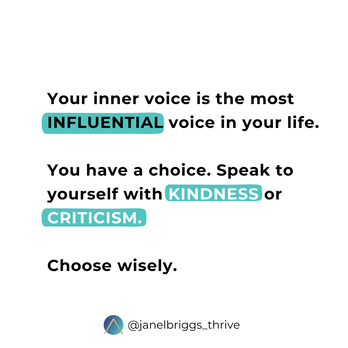
✨ Start by becoming aware of your critical thoughts, feelings, and self-talk
 
✨ Commit to treating yourself with the same kindness and understanding that you would offer to a close friend
 
✨ When you walk past that mirror – what would you say to your bestie? Would you ridicule her and tear her down OR would you show her compassion and pump up her tires?
 
You always have a choice; you can continue the path you’ve been on and keep get the same results. Or you can make a change and BE the source of love and acceptance in your own life.

 

Picture
About the Author: 
Janel Briggs is an Author, Mindset Coach, Practitioner of NLP and Timeline Therapy on a mission to support women across the world in overcoming their  anxiety - personal insecurities and professional fears - to build unwavering confidence and self-belief. Mindset Coaching aims to help you fearlessly elevate your life and career, and more importantly the relationship you have with yourself! Connect with Janel on social media via Linkedin or Instagram.

Picture
0 Comments
read more
Back to Blog

Tapping Into the Magic Within You

8/10/2023

 
Picture
In my line of work it's common for me to see women grappling with self-doubt. Sadly, this lack in belief can be the major cause of our stress, anxiety, burnout and even depression. 

We seem to live in a world where women feel there is a persona or invisible achievement list they have to live up to in order to be "worthy" or "valued".

Watching the Barbie movie recently, this became even more clear to me. (Have you seen it? What did you think of it?)

The gremlin thoughts in our mind often make us feel that if we don't look like THIS, or have THAT, or achieve THIS, then we're failing, "not good enough" or will "never be good enough".

It's a pressure that is hard to comprehend and manage. 

And, if we've experienced knock backs at any stage of our life or career, the journey to quiet the gremlins and get back to self-confidence can be super challenging. 

But I am here to remind you that this journey back to your true self, can also be incredibly rewarding. 
​

Within each and every one of us, there exists a reservoir of magic waiting to be tapped into. Special qualities, characteristics, talents, and brilliance that once recognised helps to light up the world in small or big ways.

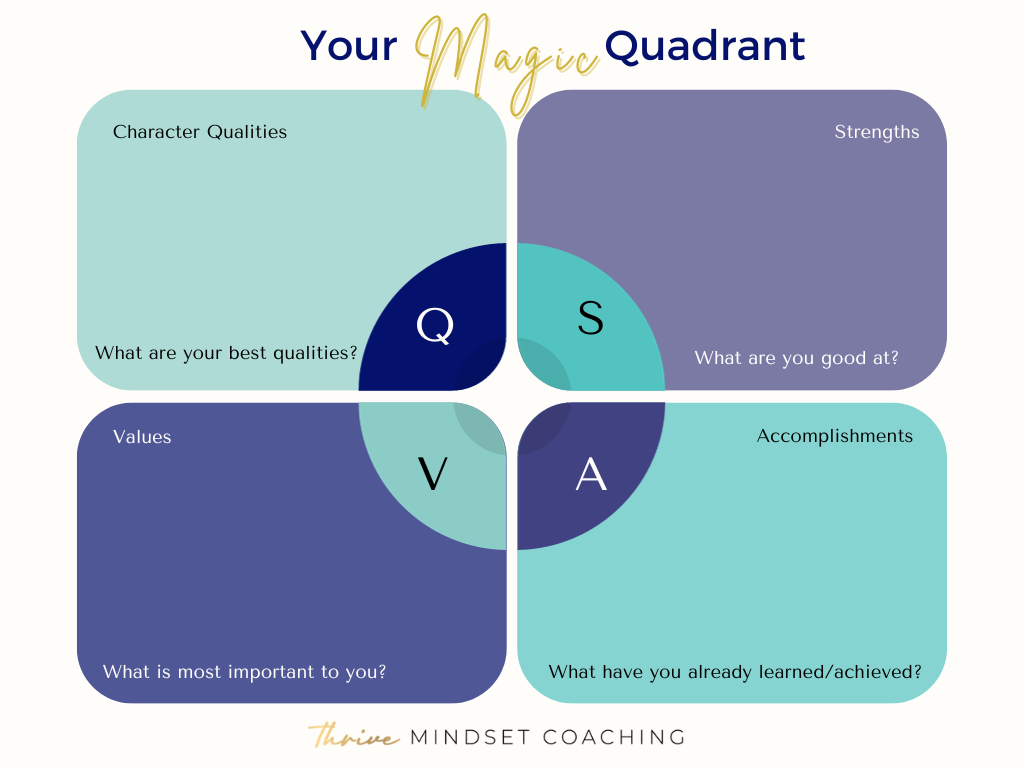
Learning how to unlock our magic is how we overcome self-doubt. Your magic sparkles from your qualities, strengths, values and known accomplishments.  ​
Picture
If you're on this journey now - I have created a visual thought starter for you. Take a blank piece of paper, grab a pen, and divide your page into four. Ask yourself each of these questions, and fill in a few dot points for each box.
Confidence blooms from deeply knowing and understanding yourself, embracing your unique qualities, and acknowledging your accomplishments. These elements will help you to go onto look at pursuing your passions.

Mindset Coaching: The Key to Unleashing More of Your Magic

Mindset coaching is a powerful tool that empowers women to shift their perspective, challenge their limiting beliefs, and develop the confidence to pursue their goals.

Here's how THRIVE mindset coaching can further help you tap into the magic within YOU:

1)  Identifying Limiting Beliefs

  • Mindset coaching starts by identifying and acknowledging the limiting beliefs that fuel self-doubt. These beliefs often stem from past experiences, societal expectations, or comparisons with others.
  • By recognising these beliefs, you can begin to break free from their grip and learn how to replace them instead with empowering thoughts.

2)  Cultivating Self-Awareness

  • Self-awareness is a cornerstone of mindset coaching. It involves understanding your thoughts, emotions, and triggers. 
  • When you know yourself and how you operate, it becomes easier to recognise when self-doubt starts to creep in and take steps to counteract it.

3) Shifting Negative Self-Talk

  • The inner dialogue we have with ourselves plays a significant role in self-doubt. Mindset coaching helps women replace negative self-talk with positive affirmations and self-compassion.
  • Instead of saying, "I can't do this," you'll learn to say, "I am capable, and worthy and deserving of THIS (and everything else!)."

4) Setting Empowering Goals

  • Mindset coaching encourages women to dream about the future and set realistic yet challenging goals for yourself.
  • These goals become stepping stones towards building the life and world you want to see and feel. Each small step reinforces your belief in your abilities and brings you closer to unleashing your inner magic.

5) Building Resilience

  • Stress resilience is a crucial trait in overcoming self-doubt. Mindset coaching teaches you to view setbacks as opportunities for growth rather than failures.
  • When you bounce back from challenges, you'll discover a newfound strength within yourself.

Your inner magic is wating to shine. Remember, you are capable and worthy of achieving greatness!
1:1 Mindset Coaching

Honour your uniqueness, own your story, and believe in your capabilities. THIS level of radical self-acceptance is where the magic sparkles within you!


Picture


​About the Author: Janel Briggs is a NLP and Timeline Therapy Practitioner on a mission to support women across Australia and Singapore in overcoming their professional anxieties, imposter syndrome, fears and insecurities to build unwavering confidence and self-belief. Mindset Coaching is about learning how to  become fearless and level up your life and career! Connect with Janel on social media via Linkedin or Instagram.

0 Comments
read more
Back to Blog

Beyond the Angry Storm: Understanding and Processing Emotions

31/7/2023

 
Picture
We've all faced moments when emotions surge within us like an angry storm. Emotional outbursts, fiery and fierce in intensity take centre stage and knocks us off our center. Defensive barriers go up, words are said, and actions are taken that don't always leave us feeling good.

What I've learned is that most of the time, it's not really about "the thing" that triggered the angry storm... is it? 
  • It's not really about the coffee cup and dirty dishes someone left in the sink
  • It's not really about the changes at work, or your boss favouring someone else at review time
  • It's not really about the family member's comment or opinion at the last catch up

Although those things are super ANNOYING ... they are just the tip of the iceberg, aren't they?

It's MORE THAN that "one thing" presenting itself... it goes deeper than that.

As a Mindset Coach it's my role to help YOU understand what is laying underneath those icy waters at the base of the iceberg.

Where the anger is in fact fueling from.

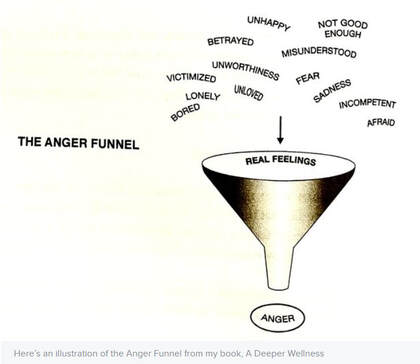
Anger itself is largely perceived as a secondary emotion that shows up when we feel we need to defend ourselves.

Most often, it's about OUR NEEDS.

What the anger is usually saying is ... when X happens (at home, work, in this relationship) I don't feel:
valued.
loved.
appreciated.
included.
understood.
seen.
heard.
special.

Am I right??
Picture
​Further reading: great article on anger here. (Image Cred. Monica Vermani C. Psych.)
​LEARNING TO RELEASE & PROCESS  ANGER.

Internalised anger and resentment acts like poison in the body, and  will eventually end up festering and eating away  at the container it is in.

The anger held deep down inside, has to come out sometime. It won't stay locked up forever.

Sudden outbursts, conflicts and arguments begin to show up in other areas of your life for no aparent reason - not just with the person you originally felt angered by.

So, what can you do to release and process before it festers?

How to process emotions is sadly not a skill they teach us at school. I call it a skill because it'rs super important to learn and it takes awareness and practice to master.

In my belief journaling the #1 way to process your emotions. Here's how you can get started:

TUNE INTO THE REAL SOURCE OF YOUR ANGER:

  1. What specifically is causing me to feel angry/irritated/frustrated?

  2. Is it really about this one thing, or is it more than that?

  3. How are my needs are not being met?

  4. Where am I holding anger in my body?
​
  5. Acknowledge the true feelings beneath your anger (acceptance) and ask - what do I need to do in order to be at peace?


From here, you'll get clear on the next best course of action.

J A N E L  B R I G G S
Thrive Mindset Coaching


And, as always if you need more guidance please reach out via DM. Learn more about my 1:1 coacing programs here. TimeLine Therapy is an incredible tool for guiding you to release anger (and various other negative emotions) from it's core and get to the root of the problem. 



Picture

​About the Author: Janel Briggs is a NLP and Timeline Therapy Practitioner on a mission to support women across Australia and Singapore in healing their professional anxieties, insecurities and imposter syndrome to build unwavering confidence and self-belief. The goal is to level up your life and career by learning how to to live fearless and anxiety free! Connect with Janel on social media via Linkedin or Instagram.

0 Comments
read more
Back to Blog

Take Your Power Back: The Key to Lasting Happiness

11/6/2023

 
Picture
​Have you ever found yourself seeking happiness through external validation?

For years, I placed my happiness in the hands of others, constantly thinking that if certain people or circumstances aligned in a certain way, then I would finally be happy.
​
I would catch myself saying things like, "If my parents, sister, husband, son, boss, colleague, or X did THIS, then I would be happy."

I tied my happiness to achieving good grades, receiving recognition at work, earning a promotion, or even reaching specific milestones in my first business.

My joy was dependent on external factors and the validation they provided.

The problem was, and what I've realised through Mindset Coaching, is that MY long term happiness is an internal job... I am the only one that can change it or make it happen.

Yes, the external factors could give me a temporary hit of happiness, BUT they could never give lasting contentment. Here's why:

Picture

* We cannot control the external factors! Or other people's opinion of us

*   We cannot control how much or little someone loves us! Or HOW they specifically show us love

The key was... I had to learn to know, love and accept MYSELF (all facets and parts of me) - in order to find my self-worth and experience a contentment that I never even knew existed.

And the most amazing thing happened, when I stopped seeking external validation...

I got my power back!

​In this video, I share the three crucial steps I took to break free from the cycle of seeking external validation and find true self-worth.

Let me detail the 3 steps I took for you here:

1. Get clear on what is in your control and what isn't

I learned that I cannot control other people's actions, reactions, behaviours or even the way they love and treat me. I cannot control every single outcome, to every situation in my life.

​There will be uncertainty, there will be change, there will be things that do not always go my way. No matter how hard I work or try to make it different. 

I can only control what is within my circle - my mind, my body, my emotions and my behaviours. How I think, reaction and respond is up to me. 

2. Start your day with a focus on self-care

I started my day with a simple shift. In order to love myself fully and build self-worth I need to be the most important person in my world, my needs matter. My own self-care has to be a priority. 

I decided to wake up 15 mins earlier, to sit listening to a short 5 min guided meditation and I did 10 mins of journaling positive affirmations - something I had never done before!  (If you are new to meditation I have a few to help get you started here)

I spent 10 mins stretching and doing yoga, then ate a healthy nourishing breakfast and I listened to music while getting ready for work. 

I found this short 20-30mins of "me-time" first thing in the morning would calm and refocus my mind, before the chaos of the day began.

When I filled my "needs cup" first, I found I wasn't looking to other people or external factors to fill my own needs. 

3. Do one thing this week that brings you JOY

I began a new habit where once a week I would do something that brough me joy - something just for me. Where I didn't have to do anything for anyone else. 

You see, I began to remember who I was outside of all the labels and hats I wore. Outside of the expectations, demands, stress and achievements of work. 

I started to love and reconnect to my inner child, the part of me that had gotten lost from putting all my happiness eggs outside my own basket. The part of me that was waiting for someone else to love, care and adore me, the way I wanted. 

It's an empowering feeling not waiting for someone to give you everything you need.

I began to breathe easier and smile more often. Life felt less heavy and more enjoyable.  

I realise that it had to start with me, just like it has to start with you.

And I am here to tell you - YOU can absolutely do it too. 

​JB

Picture


​About the Author:
 Janel Briggs is a NLP and Timeline Therapy Practitioner on a mission to support women across Australia and Singapore in healing their professional anxieties, insecurities and imposter syndrome to build unwavering confidence and self-belief. The goal is to level up your life and career by learning how to to live fearless and anxiety free!
 Connect with Janel on social media via Linkedin or Instagram.

VISIT 1:1 COACHING FOR MORE INFO
0 Comments
read more
Useful Links

Shop
About
Coaching
Free Affirmations List​
Home
Get in touch

Email: [email protected]
Picture
Picture
Stay Connected!
Subscribe and be the first to access new coaching content, news & updates.
SUBSCRIBE TODAY
By clicking “I accept” you confirm that you have read and accepted Janel Briggs’ Privacy Policy and Privacy Collection Notice.
Collection Notice    |     Privacy Policy    |    Terms and Conditions